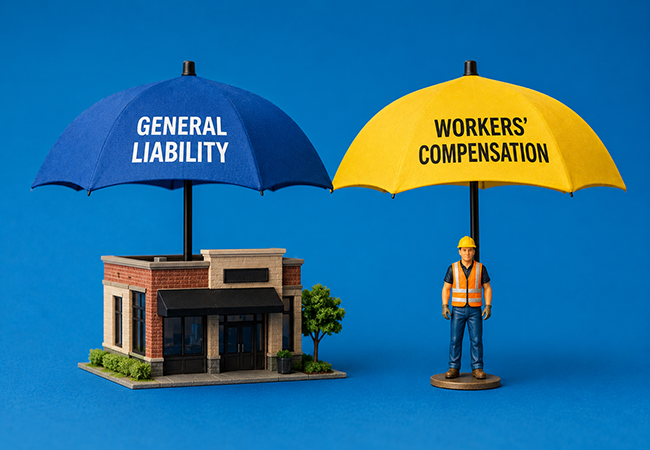

High-risk workers comp is designed for businesses that standard insurance carriers often decline due to higher injury exposure, prior claims, or complex payroll structures. If your business has been classified as high-risk, the solution is not to lower your risk — it is to work with providers that are built to insure it.
Industries like construction, staffing, and manufacturing consistently rank among the highest for workplace injuries. According to the Bureau of Labor Statistics (BLS), these sectors report significantly higher rates of nonfatal workplace injuries compared to lower-risk industries, which directly impacts how insurers evaluate and price coverage.
—What Is Considered High-Risk in Workers Comp?
Insurance carriers classify businesses as high-risk based on exposure to injury, payroll volatility, and historical performance.
Common High-Risk Business Types
- Construction companies: Roofing, framing, and heavy labor roles
- Staffing agencies: Especially those placing workers in manual roles
- Manufacturing: Machinery and repetitive motion injuries
- Logistics and transportation: Driving and physical handling risks
Other High-Risk Factors
- Previous workers comp claims
- Lapses in coverage
- Rapid payroll growth
- Misclassification of employees
Learn more about high-risk businesses that may require workers comp coverage.
—Why Standard Insurance Companies Decline High-Risk Businesses
Traditional carriers are built to operate within predictable risk parameters. When a business falls outside those limits, the easiest decision for the insurer is to decline the application.
Main Reasons for Declines
- High claim frequency: Increased likelihood of payouts
- Severity of injuries: Higher medical and indemnity costs
- Unpredictable payroll: Makes pricing difficult
- Compliance risk: Especially with subcontractors or classification issues
This does not mean your business cannot be insured. It means you need a different type of provider.
If you’ve been denied coverage, it’s important to understand your options before accepting assigned risk. In some cases, you may still be able to appeal a workers comp denial and improve your chances of approval, depending on the reason for rejection.
—How Workers Comp Costs Increase for High-Risk Businesses
Workers comp premiums are calculated per $100 of payroll, and high-risk industries have significantly higher rates.
Typical Cost Ranges
- Low-risk industries: $0.75 – $2 per $100 payroll
- Moderate risk: $3 – $10 per $100 payroll
- High-risk industries: $10 – $40+ per $100 payroll
For example, a construction company with $500,000 in payroll could pay significantly more than a professional services firm with the same payroll.
Costs depend on:
- Class codes assigned to employees
- Claims history
- State regulations
- Experience modification rate (EMR)
How to Get Workers Comp Coverage as a High-Risk Business
The key to getting approved is not eliminating risk — it is presenting your business correctly to the right market.
Best Strategies for Approval
- Work with specialized providers: They are built to handle high-risk accounts
- Use accurate class codes: Avoid overpaying due to misclassification
- Provide clear payroll reporting: Reduces underwriting friction
- Maintain continuous coverage: Avoid lapses that trigger denials
Many businesses that are denied by standard carriers are successfully placed through specialty markets.
—Assigned Risk Pools vs Private High-Risk Coverage
If you cannot get coverage in the private market, you may be placed in an assigned risk pool. However, this is typically more expensive and less flexible.
Key Differences
- Assigned risk pool: Guaranteed coverage, higher cost, limited flexibility
- Specialized providers: More control, better pricing structure, tailored policies
Whenever possible, private high-risk coverage is the better long-term option.
—Common Mistakes High-Risk Businesses Make
- Applying with the wrong carriers repeatedly
- Using incorrect class codes
- Ignoring subcontractor compliance
- Delaying after a denial
These mistakes can limit options and increase costs over time.
—Conclusion
Being classified as high-risk does not eliminate your ability to get workers comp — it changes how you should approach the market. The right provider can structure coverage around your business instead of rejecting it.
The goal is not just to get approved, but to secure a policy that fits your operations, controls costs, and remains stable as your business grows.
High-risk business? We specialize in difficult approvals and flexible coverage — get a quote in minutes:
https://ocmiworkerscomp.com/workers-comp-calculator-blog/u/step-1