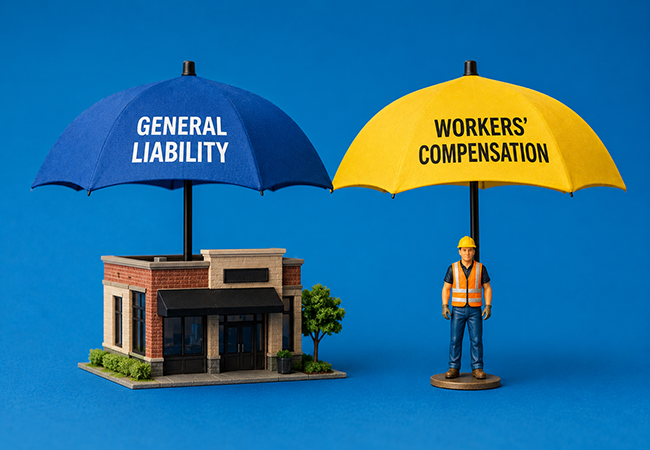

Workers comp for 1099 employees in Florida is not as simple as “contractors don’t need coverage.” Under Florida’s Chapter 440, construction-industry contractors generally must be covered even when they’re paid on a 1099, while many non-construction independent contractors are not required to be. The catch: misclassifying a worker or hiring an uninsured subcontractor can make your business liable for their injury. What you must know is how Florida defines the relationship for your industry — before a claim tests it.
Here’s a scenario that keeps many Florida business owners up at night: A contractor you hired falls from a ladder on your job site, suffers a serious injury, and suddenly you’re facing questions about medical bills, liability, and potential lawsuits. You assumed that because they’re a 1099 worker, you were protected. But were you?
Understanding workers comp for 1099 employees in Florida isn’t just a matter of legal compliance—it’s about protecting your business, your finances, and the people who help your company thrive. The rules are nuanced, the stakes are high, and misinformation runs rampant. Whether you’re a construction company owner, a staffing agency director, or an HR professional managing a blended workforce, this guide will give you the clarity you need to make informed decisions.
In Florida, the relationship between independent contractors and workers’ compensation insurance is governed by specific statutes that don’t always align with federal classifications or common assumptions. By the end of this article, you’ll understand exactly when coverage is required, how to protect your business from costly misclassification penalties, and what options exist for workers comp insurance for 1099 employees in the Sunshine State.
Do 1099 Employees Need Workers Comp in Florida? Understanding the Legal Framework
The question “do 1099 employees need workers comp” is one of the most frequently asked—and most commonly misunderstood—questions in Florida employment law. The short answer is: it depends on your industry, your total workforce composition, and how Florida law classifies the relationship.
Florida’s workers’ compensation requirements are primarily outlined in Chapter 440 of the Florida Statutes. Unlike some states with blanket exemptions for independent contractors, Florida takes a more nuanced approach that varies significantly by industry.
General Industry Requirements
For most non-construction businesses in Florida, workers’ compensation insurance becomes mandatory when you have four or more employees. Here’s where it gets complicated: under certain circumstances, independent contractors may be counted toward that threshold.
If Florida determines that your 1099 workers are actually employees under the state’s classification tests—regardless of how you’ve labeled them—they’ll count toward your employee total. This means a business owner who thinks they have three employees and two independent contractors might actually be required to carry coverage if those contractors are reclassified.
Construction Industry: A Different Standard
The construction industry operates under significantly stricter rules. In Florida, construction companies must carry workers’ compensation insurance if they have even one employee—and independent contractors in construction are treated very differently than in other industries.
According to Florida Statute 440.02, construction industry independent contractors must either:
- Obtain their own workers’ compensation coverage
- Provide a valid Certificate of Exemption from the state
- Be covered under the hiring company’s policy
If a construction subcontractor doesn’t have their own coverage or exemption, the general contractor or hiring company becomes responsible for providing coverage. This is a critical point that many construction business owners overlook, often with expensive consequences.
Agricultural Industry Considerations
Agricultural operations have their own threshold: coverage becomes mandatory when you have six or more regular employees, or twelve or more seasonal workers who work more than 30 days in a season. The classification of 1099 workers in agricultural settings follows similar principles to general industry.
Cover the gap before it costs you
The expensive surprises happen when an “independent contractor” is later treated as your employee, or an uninsured sub gets hurt on your job. OCMI specializes in high-risk, blue-collar Florida businesses and offers no-deposit, no-audit pay-as-you-go coverage with same-day approvals. Estimate your OCMI workers comp cost and protect against the classification gap.
Are 1099 Employees Covered by Workers Comp? The Classification Question
When business owners ask “are 1099 employees covered by workers comp,” they’re often really asking whether their current classification of workers will hold up under scrutiny. Florida uses specific criteria to determine whether someone is truly an independent contractor or whether they should be classified as an employee entitled to benefits.
Florida’s Independent Contractor Test
Florida courts and the Division of Workers’ Compensation examine multiple factors to determine worker classification:
- Control over work: Does the worker control how, when, and where the work is performed?
- Financial investment: Does the worker have a significant investment in equipment or materials?
- Opportunity for profit or loss: Can the worker’s business decisions affect their profit?
- Permanency of relationship: Is the relationship project-based or ongoing?
- Skill required: Does the work require specialized skills not typically directed by an employer?
- Integration into business: Is the worker’s service integral to the hiring company’s business?
Simply issuing a 1099 form and having a signed independent contractor agreement doesn’t guarantee that Florida will recognize the relationship as a true independent contractor arrangement. The state looks at the substance of the relationship, not just the paperwork.
The Risks of Misclassification
The consequences of worker misclassification in Florida are severe and have become increasingly enforced. According to the Florida Department of Financial Services, misclassification penalties can include:
- Stop-work orders that immediately halt all business operations
- Penalties of $1,000 per day for each day of non-compliance
- Liability for all medical expenses and lost wages if an uninsured worker is injured
- Criminal charges in cases of fraud or willful non-compliance
- Back payment of premiums plus penalties and interest
A 2023 study by the National Employment Law Project estimated that worker misclassification costs state unemployment insurance trust funds billions of dollars annually, leading to increased enforcement efforts nationwide—and Florida is no exception.
Do I Need Workers Comp for 1099 Employees? A Decision Framework
If you’re asking yourself “do I need workers comp for 1099 employees,” here’s a practical framework to guide your decision-making process.
Step 1: Evaluate Your Industry
Your industry classification dramatically affects your obligations:
- Construction: Almost certainly yes, you need to address coverage for all workers on your job sites
- General business with 4+ total workers: Potentially yes, depending on classification
- Agricultural with seasonal workers: Threshold-dependent coverage requirements
Step 2: Honestly Assess Worker Relationships
Be brutally honest about whether your 1099 relationships would survive a state audit. Ask yourself:
- Do I dictate specific work hours?
- Do I provide all equipment and materials?
- Is this person working exclusively for my company?
- Do I control the manner in which work is performed?
If you answered yes to multiple questions, your 1099 workers may be considered employees under Florida law, and 1099 employee workers comp coverage may be required.
Step 3: Consider the Risk Exposure
Even when coverage isn’t legally mandated, the risk exposure of working with uninsured contractors can be substantial. If a contractor is injured on your premises or while performing work for your business, you could face:
- Personal injury lawsuits
- Property damage claims
- Medical expense liability
- Loss of business reputation
Many Florida business owners choose to require 1099 workers comp coverage from their contractors—or include contractors under their own policies—simply as a risk management strategy, regardless of legal requirements.
Workers Comp Insurance for 1099 Employees: Coverage Options in Florida
Understanding your options for workers comp insurance for 1099 employees helps you choose the most cost-effective and appropriate approach for your business situation.
Option 1: Require Independent Contractors to Carry Their Own Coverage
The cleanest approach is requiring all 1099 contractors to maintain their own workers’ compensation insurance. This strategy:
- Shifts liability to the contractor
- Confirms their status as a true independent business
- Protects your business from claims
- Reduces your insurance premiums
When implementing this approach, always obtain and verify current Certificates of Insurance (COIs) before work begins. Set up a system to track expiration dates and require updated certificates as policies renew.
Option 2: Include Contractors Under Your Policy
Some Florida business owners choose to include 1099 workers under their own workers’ compensation policy. This approach:
- Provides certainty of coverage
- Simplifies compliance in construction settings
- May be required by your general liability insurance
- Increases your premium costs
If you choose this route, work with your insurance agent to accurately report all workers—including 1099 contractors—to ensure adequate coverage and avoid audit surprises.
Option 3: Obtain Certificates of Exemption
In Florida’s construction industry, sole proprietors and certain corporate officers can apply for a Certificate of Exemption from workers’ compensation requirements. These exemptions:
- Must be applied for through the Florida Division of Workers’ Compensation
- Are valid for two years
- Require the exempt individual to waive their right to workers’ compensation benefits
- Do not protect the hiring company if the exemption is invalid
Always verify exemption certificates through the Florida Division of Workers’ Compensation’s online database. Fraudulent or expired exemptions leave you liable.
1099 Workers Comp: Best Practices for Florida Businesses
Implementing strong policies around 1099 workers comp protects your business and creates clear expectations for all parties involved.
Create a Contractor Compliance Program
A formal contractor compliance program should include:
- Pre-qualification requirements: Insurance minimums, licensing verification, and safety certifications
- Contract language: Clear indemnification clauses and insurance requirements
- Ongoing monitoring: Regular verification of continued coverage
- Documentation systems: Organized records of all contractor documentation
Review Contracts with Legal Counsel
Your independent contractor agreements should be reviewed by an attorney familiar with Florida employment law. Key provisions to include:
- Explicit acknowledgment of independent contractor status
- Insurance requirements and coverage minimums
- Indemnification and hold-harmless clauses
- Right to verify and audit insurance coverage
Conduct Regular Classification Audits
At least annually, review your 1099 relationships to ensure they still qualify as independent contractor arrangements. Business relationships evolve, and what started as a legitimate contractor relationship may have shifted toward employment over time.
Consider engaging a third-party HR consultant or employment attorney to conduct these audits objectively.
The Cost of Workers Comp for 1099 Employees in Florida
Understanding the financial implications helps you budget appropriately and make informed decisions about contractor relationships.
Factors Affecting Premium Costs
When 1099 workers are included in your workers’ compensation policy, premiums are calculated based on:
- Classification codes: Different job types carry different risk ratings
- Payroll or contract amounts: Premiums are typically calculated as a percentage of compensation
- Experience modification rate: Your claims history affects your rate
- Industry risk factors: Some industries simply cost more to insure
According to the National Academy of Social Insurance, Florida’s workers’ compensation costs are near the national average, with employers paying approximately $1.30 per $100 of payroll in recent years—though this varies significantly by industry and classification.
Cost-Benefit Analysis
While workers’ compensation insurance represents a real cost, the alternative can be catastrophic. Consider that:
- The average workers’ compensation claim in Florida exceeds $40,000
- Severe injuries can result in claims exceeding $1 million
- Legal defense costs add substantially to uninsured claim expenses
- Stop-work orders can devastate ongoing business operations
When viewed through this lens, appropriate insurance coverage is almost always more cost-effective than self-insuring the risk.
Workers Comp for 1099 Employees: Navigating Common Scenarios
Let’s examine how workers comp for 1099 employees requirements apply to common Florida business scenarios.
Scenario 1: The General Contractor
You’re a general contractor who hires various subcontractors for residential construction projects. Under Florida law, you must:
- Verify that each subcontractor has their own workers’ compensation coverage or valid exemption
- Maintain copies of all certificates
- Report any uninsured subcontractors to your insurance carrier (they’ll be added to your policy)
Scenario 2: The Professional Services Firm
You run a marketing agency with three W-2 employees and regularly engage freelance designers and writers. In this scenario:
- You’re below the four-employee threshold for mandatory coverage
- Your true independent contractors likely won’t trigger requirements
- However, consider voluntary coverage for risk management purposes
Scenario 3: The Staffing Agency
You operate a staffing agency placing workers at client sites. This is complex territory:
- Workers placed at client sites are typically your employees, not independent contractors
- You almost certainly need workers’ compensation coverage
- Client contracts should address insurance responsibility clearly
Conclusion: Protecting Your Florida Business with the Right Workers Comp Strategy
Understanding workers comp for 1099 employees in Florida is essential for protecting your business, maintaining compliance, and managing risk effectively. The key takeaways are clear:
- Florida’s requirements vary by industry, with construction facing the strictest standards
- Classification matters more than labels—substance over form determines worker status
- Misclassification penalties are severe and enforcement is increasing
- Workers comp insurance for 1099 employees may be legally required or simply smart risk management
- Documentation, verification, and ongoing compliance monitoring are essential
Don’t leave your business exposed to unnecessary risk. Whether you’re legally required to provide 1099 employee workers comp coverage or choosing to do so proactively, working with experienced insurance professionals and legal counsel ensures you make the right decisions for your specific situation.
Frequently Asked Questions: Workers Comp for 1099 Employees in Florida
Do 1099 workers need workers comp in Florida?
It depends on the industry. In Florida construction, contractors and most 1099 workers must be covered. Outside construction, genuine independent contractors usually aren’t required to be — but the legal test looks at the real relationship, not just the 1099 label. OCMI covers this in do I need workers comp in Florida if I have a 1099.
Am I liable if a 1099 contractor gets hurt on my job?
You can be. If the worker is reclassified as your employee or is an uninsured subcontractor, your business may be responsible for their injury costs. Collecting a valid certificate of insurance from every sub is the key protection.
Can I require subcontractors to carry their own workers comp?
Yes, and you should. Requiring and verifying each sub’s coverage shifts the risk appropriately. Learn more about when coverage can be waived for contractors.
What’s the risk of misclassifying an employee as 1099?
Penalties, back premiums, and personal liability for injuries. Florida regulators and insurers look closely at construction relationships, where misclassification is most common.
How do I know if my contractor is really independent?
Florida weighs control, independence, and the nature of the work — not the payment form. When in doubt, treat the worker as covered or confirm their own policy before they start.
Protect Your Florida Business From the Classification Trap
With workers comp for 1099 employees in Florida, the safest move is to verify status, collect certificates, and know your industry’s Chapter 440 rules before anyone gets hurt. OCMI specializes in high-risk Florida employers and offers no-deposit, no-audit pay-as-you-go workers comp with same-day approvals. Get your OCMI estimate and close the gap.
This article is for informational purposes only and does not constitute legal or insurance advice. Florida workers’ compensation rules under Chapter 440 are fact-specific and change over time. Consult a licensed Florida insurance professional or attorney for guidance specific to your business.